
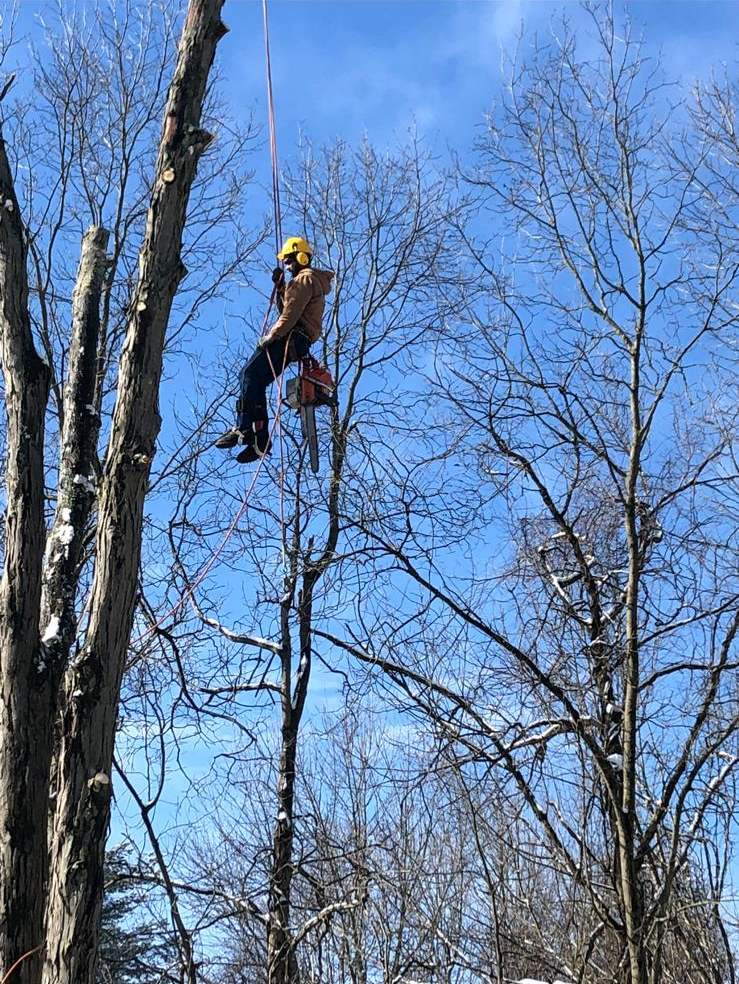
If you have a tree that needs to come down, the best time to do it in Massachusetts is late fall through winter. The leaves are off, so you can see what you are dealing with. The ground freezes, so the trucks do less damage. Nothing in the garden is growing. And the storms that bring trees down on houses mostly come between November and March, so the dead one over the roof should be gone before they arrive, not after.
Every fall the phone gets busy the same way. The first nor'easter comes through, a few trees come down, and the people who had been meaning to call about a tree all summer call now. One customer wrote this at the end of September, the week after a storm:
“A sizable tree came down in my yard from the Nor'Easter this weekend. Called Adam, who came out and gave me a competitive quote. That very afternoon he and his team came by to take away the fallen tree, along with 2 others that needed to be removed.”

The two other trees are the point of this post. The ones that fall in a storm are nearly always the ones that were already dead, hollow or rotting at the base. They were going to fail. The storm just picked the day. Taking that tree down on a calm weekday in December costs a lot less than taking it off your roof in a January ice storm, and your insurance company would rather you did it that way too.
Five reasons the cold months are better
1. You can finally see the tree
In July a big maple is a green wall. In November it is a skeleton, and everything that matters is in plain sight: dead limbs, a crack where two trunks meet, a cavity halfway up, woodpecker holes, bark that has fallen off a whole side. When Adam walks the yard with you in the fall he is reading the tree, not guessing at it, and the price he gives you is for the job he can actually see.
2. Frozen ground protects your lawn
Tree removal means trucks, a chipper and often a crane or a skid steer in your yard. We lay plywood down whatever the season, but ground that has frozen hard takes that weight with no ruts at all, and the crew can usually get the equipment closer to the tree. Closer means fewer pieces carried across the lawn, which means a faster job. Several customers have told us they could not find a tire mark afterwards. Winter is when that is easiest to deliver.
3. Nothing is growing underneath it
Perennial beds are cut back, the vegetable garden is done, the hostas are gone until May. Limbs and brush that would flatten a flower bed in June land on bare mulch in December. If the tree comes out in winter, you have the whole spring to seed the bare spot, grind the stump and plant something new, instead of looking at a patch of sawdust all summer.
4. The storms are ahead of you, not behind you
Around Bolton, Hudson, Stow and the rest of MetroWest the trees that land on houses do it in nor'easters, in the wet October and April snows that stick to leaves and limbs, and in ice. Those all come in the cold months. A dead oak over the bedroom is a planned removal in November and an emergency call in February. The planned version is cheaper, safer, and does not involve a tarp on your roof.
There is an insurance angle too. In Massachusetts a homeowner's policy generally pays to get a tree off a house, a garage or a fence. It usually pays nothing to remove a standing tree you know is dead, and nothing for a tree that falls and hits only the lawn. So the dead tree is your bill either way. The difference is whether you also get a roof bill.
5. The crew has more room in the schedule
September and October are the busiest weeks of the year for any tree company in this part of the state. People come back from vacation, the first storm hits, and everyone calls at once. By December the calendar opens up. An estimate that might take a few days to schedule in early October often happens the next day in January, and the job itself follows sooner.
“They came out the next day in the busy fall season. Excellent work with large trees near my house that had to be lowered carefully.”
What is not better in winter
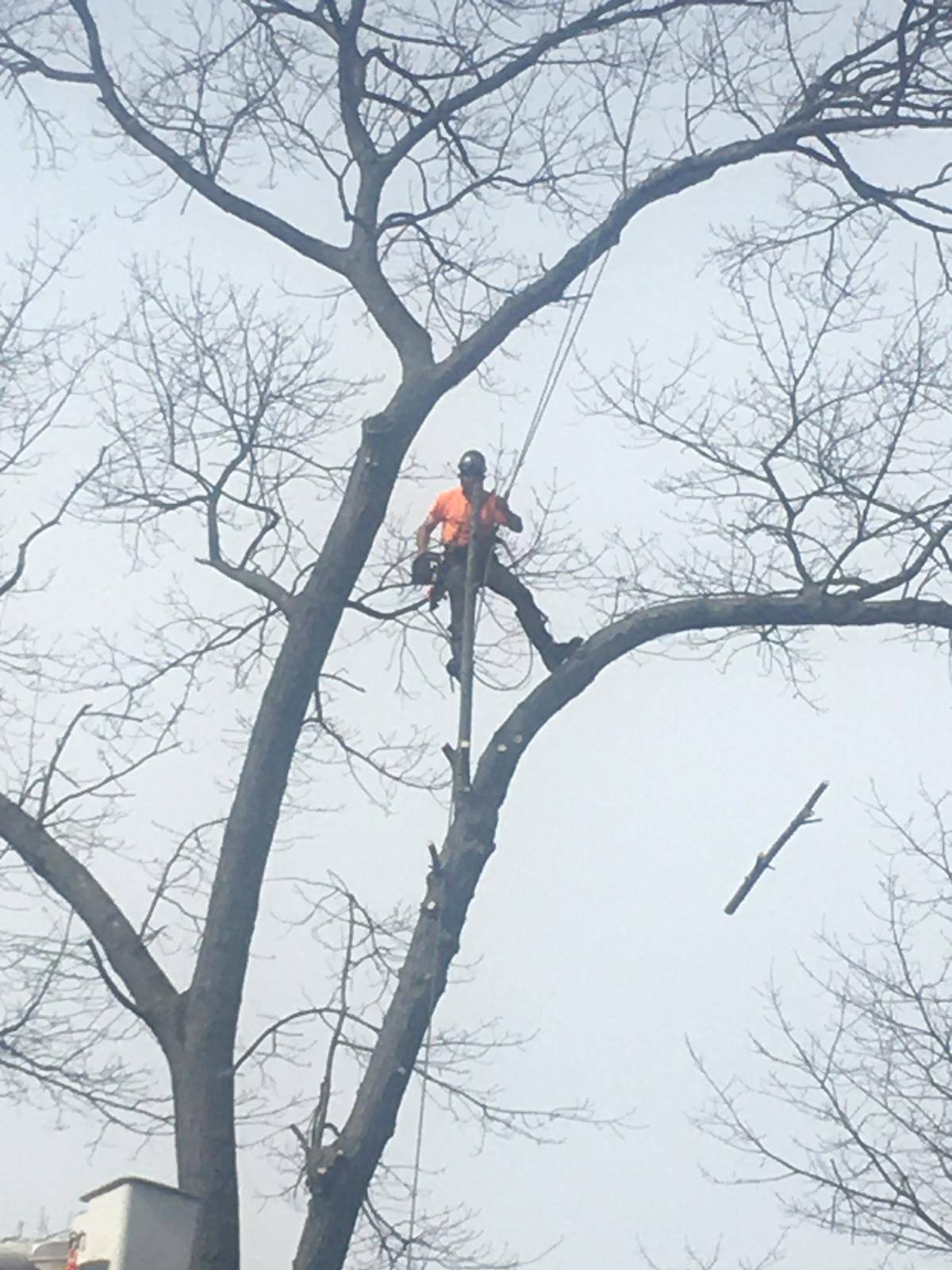
Honesty cuts both ways. Deep snow slows a job down, because the crew is wading and the brush has to be dug out before it is chipped. Ice on the limbs stops climbing altogether until it melts, for the same reason you would not walk on it. And stump grinding is the one task that gets harder once the ground is frozen solid, because the grinder has to work through frozen soil around the stump. If the stump needs to go, we try to grind it on the same visit as the removal, or come back for it on a thaw or in early spring.
None of that is a reason to wait. It is a reason to call in November rather than February if you have the choice.
How to tell a tree should come down before winter
Walk around it now, while there is still daylight after work, and look for these:
- A dead top, or whole limbs with no leaves while the rest of the tree still has them.
- Mushrooms or shelf fungus growing out of the trunk or from the roots at the base. That is rot you cannot see the rest of.
- A crack running down the trunk, or a tight V where two trunks meet with bark pinched between them.
- Bark falling off in sheets, or sawdust at the base from borers.
- A lean that is new, or soil lifting and cracking on the side away from the lean.
- A hollow you can see into, or a trunk that sounds hollow when you knock on it.
- It stands over the house, the driveway, the wires or the spot where you park, and any of the above is true.
One of those does not always mean removal. A dead limb can be pruned out. A lean the tree has had for twenty years is probably fine. If you are not sure, that is what a tree inspection is for: Adam looks, tells you what needs to come down now and what can wait, and you decide. Taking a tree down that did not need to go is not a service to anyone.
And if the tree is staying?
The same cold months are the right time to prune most hardwoods, for the same reasons: the structure is visible, the tree is dormant, and the lawn is protected. Oaks in particular should only be pruned in the cold. There is more about that on the trimming and pruning page.
What it costs
The season does not change the price. The tree does: how tall it is, what is under it, how close a truck can get, and whether it has to be climbed and roped down or lifted out with the crane. A small tree in the open is a few hundred dollars. A tall pine over a roof runs into the thousands. Adam prices every job in person, for free, and you have the number before anything is cut.
Questions people ask about winter tree work
Can you take a tree down when there is snow on the ground?
Yes. A few inches of snow changes nothing. Deep snow slows the cleanup, and ice on the limbs stops climbing until it melts, so a job sometimes moves a day or two for the weather. Storm emergencies are worked as soon as it is safe.
Does tree removal cost less in winter?
Not as a rule. The price is set by the tree and what is around it, not the month. What you do get in winter is a quicker estimate, an earlier date, and less damage to the yard.
Can stumps be ground in winter?
Usually, until the ground freezes hard. After that it is slower work. We grind on the day of the removal when we can, or come back on a thaw.
Do I need a permit to remove a tree in the winter?
The season makes no difference. A tree fully on your own land normally needs no permit. Trees along a public road belong to the town and go through the Tree Warden, trees near wetlands can involve the Conservation Commission, and scenic roads have their own rules. We tell you which applies when we look at it.
How far ahead should I book?
In October, call now and expect the estimate within a few days. From December on, a few days to a week covers most jobs. Trees that are a danger to the house go first whatever the month. Call or text (857) 256-1222.